Building lighting · Installation at height
Facade Lighting: Building Lighting and LED Installation
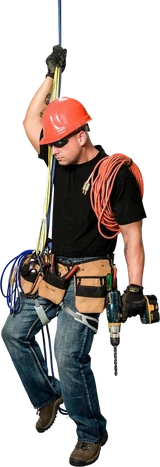
In facade lighting work, the way of getting the fitting to the facade matters as much as the fitting itself. We install wall washers, linear LEDs, floodlights and LED screens using ropes hung from the roof: no cherry picker pulls up in the street, the pavement stays open, and the installation day is not set by when the lift is free.
The same team does both the first installation of a new building lighting scheme and the replacement of fittings that have gone out over the years. Your lighting designer decides where the light falls and with which fitting; our job is to carry that decision out on the facade, at height.

Building Facade LED Lighting: Wall Washers, Linear LEDs and Floodlights
- Wall washer
Light that washes the wall from end to end
Linear fittings lined up at the foot of the wall or under the eaves. For the light to spread evenly they must all sit on the same line and at the same angle; a shift of a few millimetres shows up on the wall as a shadow.
The line is marked out with a laser and the brackets are fixed to that line.
- Linear LED
Floor bands and corner lines
Slim profiles that bring out window bands, corners and floor lines. The cable and joints running along the profile are the points most exposed to water.
The number of joints is kept low and every joint is sealed watertight.
- Floodlight
Column, tower and facade detail
A spot fitting that highlights a single architectural element. Because its body is heavy, it is bolted to a load-bearing bracket, not to the wall.
The final aim is set in the evening, with the light on.
- Pixel and neon LED
Colour and movement
Colour-changing point LEDs and flexible neon runs are chained together with a control cable. A single fault in the middle of a string can put out every point behind it.
Every run is tested on the day it is fitted.
The surface the fitting has to hold on to also decides the method. On concrete and brick walls we use wall plugs; on composite panels, a connection to the sub-frame; and on curtain walls, clamps fitted to the profile. Before drilling into the facade, we check the manufacturer’s detail for the fixing points that the panel or glazing system allows.
Facade Lighting by Rope: Installation Without Closing the Street
| Item | By cherry picker | By rope access |
|---|---|---|
| Ground | A pavement or lane the size of the vehicle is closed; depending on traffic, a permit may have to be sought from the municipality. | Only a safety area of a few metres is set aside on the ground, and the footpath stays open. |
| Height | Limited by the length of the boom; on tall blocks the upper floors may be out of reach. | The team goes down to every level from the anchor set up on the roof. |
| Rear elevations | Courtyards, light wells and rear facades the vehicle cannot pull up to are out of reach. | Work is possible on every surface a rope can be fixed to. |
| Evening adjustment | Because the aim of the fittings is set with the light on, the vehicle is hired for the evening hours as well. | The team stays on the facade as it gets dark; the adjustment is made with the same descent setup. |
| A single fault | Half or a full day’s hire of the vehicle is paid even for one fitting. | One descent is enough; several faults are put right together on the same day. |
A cherry picker is still a quick solution for low buildings and for streets with plenty of space in front; we say so plainly at the site survey. Rope comes out ahead on tall blocks, narrow streets, buildings whose entrance or shop window cannot be closed, and facades that need frequent maintenance.
Our Ankara-based team travels to other provinces with its equipment for installations on office towers, hotels, mosques and residential blocks, and stays on site until the job is finished.
LED Screen, Logo and Sign Installation
LED screens and illuminated logos hung on a facade are much heavier than light fittings; what is more, they catch the wind like a sail. Installation begins with the steel support being anchored to the wall; the modules are then fitted to this support one after another.
We do not manufacture the screen or the sign. We work to the manufacturer’s installation drawing and, at points the platform cannot reach, join their team to work at height.
- Anchoring the steel support to the wall and levelling it
- Hoisting the modules up by pulley and seating them in place
- Gathering the power and data cables behind the support
- Removing old screens, logos and signs
Every hole where a cable enters the facade is sealed with the neutral facade silicone we use on curtain walls. Water follows the path the cable has opened, not the fitting.

What Determines the Cost of Facade Lighting Work
- 01Number of fittings and length of run
- How many fittings, and how many metres of profile? Fittings standing on the same vertical line are finished in a single descent.
- 02Number of descent lines
- The more the fittings are spread across the facade, the more times the rope setup has to be taken down and put up again.
- 03Facade material
- Concrete, stone, composite panel or glass; each needs its own fixing parts and time.
- 04Cable route
- Whether the cable will run in a duct or along a joint, and how far it is from the distribution board.
- 05Evening adjustment and testing
- To set the aim, the team has to stay on the facade after dark as well.
- 06Distance and season
- Travel and accommodation for jobs outside Ankara; the shorter working day in winter.
We do not give a figure per fitting or per metre on this page: the same number of fittings takes a very different time to fit on two different buildings. Once we have the project or the fitting list, we carry out a site survey and write the quote item by item.
Send Us the Project and We Will Work Out the Installation Plan Together
Information that speeds up the quote
- The lighting project or fitting list
- The number of storeys in the building
- A few photos of the facade taken from across the street
- The location of the electrical panel and the supply line
Questions We Often Hear About Lighting Installation
If you have a technical question about the control system, the power connection or the project, write to us with the fitting list; the answer will be more specific.
On facades that need frequent maintenance, permanent anchor points shorten every later descent; details are on our lifeline installation page.
What should building facade lighting be like?
Good facade lighting shows the lines of the building; it does not spill glaring light onto neighbouring windows and the street. Fittings should be placed at points that can be reached for maintenance, and cable entries should be sealed against water. Using LED fittings with a timed control reduces both energy consumption and light pollution after midnight. The design decisions are made by the lighting designer; in the installation we make sure these principles carry over correctly to the facade.
Do you supply the fittings?
No, we do not sell fittings. The materials are supplied by the project owner, the lighting company or the electrical contractor; we take on the installation on the facade and the maintenance afterwards. We count the fittings we receive before installation, and if any are missing or broken we report it before the work starts.
Do you also come for a single failed fitting?
Yes. For even a single fitting, we tie on at the roof and descend. If there are other fittings out or loose profiles on the same building, they are all gone over on the same day; this way the set-up cost is incurred only once.
Do the entrance and shops close while the installation is going on?
No. The team is only in front of the vertical strip it is working on. On the ground, an area of a few metres is cordoned off with tape in case something falls, and it is removed when the work is done; the entrance, the car park and the shop windows stay in use.