Special work · Trees
Hazardous Tree Removal
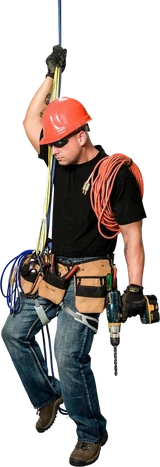
Hazardous tree removal means taking down a tree that leans towards a building, a power line or a road, piece by piece from the top, instead of felling it in one go. Our team climbs the tree on ropes, ties each piece to a separate rope and lowers it to the ground in a controlled way over a pulley.
This method is for tight spaces where there is no chance of choosing the direction the tree falls: a building courtyard, a car park, a school garden or a roadside with traffic flowing. On large trees, we also take off branches that reach over the roof, the facade or the line with the same method.

Signs That a Tree Is Dangerous
The risk varies with the species and height of the tree and what is beneath it. At the site survey we assess the lean of the tree, the area around its roots and the area where it could fall, together.
A check made before the storm season is the cheapest way of preventing a tree from falling in an uncontrolled way.
- A marked lean towards a building, a roof or a line
- Soil heaving or cracking around the roots
- Rot, a hollow or fungus at the base of the trunk
- A split running the full length of the trunk
- Thick dead branches that bear no leaves
- Branches broken in a storm and left hanging
The Piece-by-Piece Removal Method
- Step 1
Climb and main anchor
The technician climbs the tree on a rope and sets up the main anchor in the fork of a sound branch.
- Step 2
Outer branches
The outer branches are cut first; each branch is tied to a separate lowering rope.
- Step 3
Controlled lowering
The cut piece is lowered slowly to the ground over a pulley and a friction brake wrapped around the trunk.
- Step 4
Dividing the trunk
The trunk is divided from the top down into pieces small enough to carry, and lowered.
- Step 5
Stump and site
The stump is cut at ground level; the removal of the branch and trunk pieces is planned at the site survey.
On the ground, the area where the pieces come down is cordoned off with tape, and one team member manages only the lowering rope.
Once the trunk pieces are on the ground, they are cut into sizes that can be carried. Taking the timber and branch waste away from the site is stated separately in the quote.
Pruning Large Trees and Removing Branches
As with felling, the technician climbs the tree on a rope; each branch to be removed is first tied to a separate rope, then cut and lowered slowly to the ground over a pulley. In this way the branch is removed without hitting the roof, a vehicle or a line.
We decide which branches to remove at the site survey, by looking at the condition of the tree. If there is rot or a deep split in the trunk, removing branches does not solve the problem; in that case we recommend felling.
Branches reaching over the roof and facade
Branches that rub on the roof tiles, fill the gutter with leaves or lean against a window are removed close to the trunk.
Branches overhanging lines and roads
Branches reaching over a power line, a car park or a road are lowered one by one, each tied to a rope.
Thick dead or cracked branches
Thick branches that have cracked in a storm or bear no leaves are removed before they break off and fall by themselves.
- We do not prune orchards, ornamental plants or hedges; we work only on large trees that pose a risk to a building, a line or a road.
Rope, Pulley and Friction Brake: The Equipment We Use
- Climbing and safety rope
- Whenever the saw is running, the technician is attached at two separate points.
- Lowering rope and pulley
- Carries the weight of the cut piece; it is passed through the trunk or a sound branch.
- Friction brake
- The team member on the ground controls the speed of the rope wrapped around the trunk, and the piece comes down slowly.
- Saws
- A light saw that can be used one-handed up in the tree; a large saw for dividing the trunk on the ground.
- Personal protection
- Helmet, face visor, ear defenders and cut-resistant clothing.
For Municipalities, Building Managements and Institutions
Municipalities
Hazardous trees in parks, central reservations and roadsides; planned together with traffic arrangements.
Building managements
Trees leaning towards blocks, the car park or the children’s playground.
Schools, hospitals and facilities
Work is carried out while the site is in use, at the hours when it is least crowded.
A felling permit is obtained from the municipality or the relevant authority, depending on where the tree is and its species. We explain to managements what information is requested for the permit; we do not start felling before the permit is issued.
On roadside jobs, traffic signing and pedestrian diversion are part of the plan. If a lane has to be closed, the time and day are set together with the relevant department.
Working Near Power Lines and Buildings
For trees that touch or approach a power line, we speak beforehand to the distribution company that owns the line. Branches near the line are not touched until the power has been cut.
Near a building, pieces are lowered so that they are moved away from the trunk and do not hit the roof or the facade; if necessary, protection is placed in front of windows and the facade. For branches reaching over the neighbouring plot, the neighbour’s consent is obtained beforehand.
After a storm, in the case of a tree leaning on a roof or about to fall, the area is cleared first. In Ankara and the nearby provinces we go out for a site survey of this kind of job at short notice; the felling itself, even in an emergency, is done in daylight.
Let us start with a photo
Send a Photo of the Tree and Its Surroundings
A few photos showing the whole tree, the direction it leans and the structure beneath it will determine which team and equipment we bring to the site survey.