Rainwater system · Eaves level
Roof Gutter Repair and Full Gutter Replacement
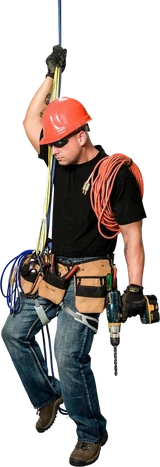
Repairing a roof gutter looks like a small job on a tall building, but to reach the gutter you either put scaffolding up over the whole facade or bring a cherry picker onto the street. We descend by rope from the roof to eaves level: we repair a sagging, holed or overflowing gutter in place, and if it cannot be saved we replace the gutter and downpipe completely.
For us, repair and replacement carry equal weight. At the site survey we walk the whole length of the gutter and show you, with photographs, which is more economical for your building.

Signs That a Gutter Needs Repair
Icicles are a separate hazard: ice that thaws and breaks off falls on pedestrians on the pavement. A check carried out before winter removes this risk to a large extent.
- Water spilling over the edge of the gutter like a waterfall in the rain
- Dripping from joints or corners
- A sagging run with water collecting in the middle
- Rusted, holed or cracked sections
- Dirt, algae and blistering paint running down the facade from eaves level
- Downpipe clamps that have snapped or come away from the facade
- Icicles hanging from the eaves in winter
Roof Gutter Repair: Joints, Holes, Fall and Bracket Repair
Joints
Leaking joints are opened up and cleaned, then resealed with rivets and sealant.
Holes and corrosion
Small holes are closed with a patch. A wide rusted section is cut out and a piece of the same profile is fitted in its place.
Fall
Where water collects, the brackets are readjusted and the run is brought to a fall that sends water to the downpipe.
Brackets and clamps
Loose or broken brackets are renewed and the downpipe clamps are fixed back to the facade.
Cleaning a blocked gutter, and curing a leak in a roof valley (internal gutter), can both be added to the same descent plan.
If water has run down the facade for years, marks remain even after the repair. If you want to refresh the paint with the same rope setup, have a look at our painting page.
Roof Gutter Replacement: When Repair Is Not Enough
| Item | Repair is enough | Replacement is needed |
|---|---|---|
| Corrosion | At one or two points, limited | Widespread along the run, metal thinned |
| Joints | A few joints leak | Most joints have opened and the sealant will not hold |
| Brackets | Some are loose | The fascia board the brackets fix to has rotted |
| Capacity | Overflows only when blocked | Overflows in a downpour even when clean; the section is too small |
| Downpipe | A single clamp has snapped | The pipe has split and its joints have parted |
In a replacement, the old run is taken down piece by piece and lowered by rope; the fascia board is repaired if necessary, and the new brackets are aligned with a fall line. The gutter and downpipe, made to measure, are hoisted up in the same way. Once the joints are sealed, the flow is checked by running water through with a hose.
Gutter Replacement Without Scaffolding: By Rope from the Roof Edge
With scaffolding
- Erected over the full height of the facade to reach the eaves
- The days for erecting and dismantling are added to the length of the job
- The pavement and garden stay closed until the scaffolding is taken down
With a cherry picker
- The vehicle has to be able to pull up in front of the building
- On tall blocks the boom may not reach the eaves
- The vehicle is repositioned every few metres
By rope
- The team descends from the anchor point on the roof to eaves level
- The team moves sideways along the eaves
- The downpipe is replaced from top to ground in a single run

The downpipe is where the advantage of the rope is clearest: the pipe runs the full height of the building, and the technician goes down from the top to the ground along with it.
In and around Ankara we recommend planning gutter checks for the autumn, after the leaves have fallen. For buildings outside the province, the team and equipment are taken to the site.
Gutter Material: Galvanised, Aluminium, Copper or PVC
| Material | Main advantage | Jointing method | Watch out for |
|---|---|---|---|
| Galvanised sheet | Economical and widely used | Rivets and sealant | Starts to rust wherever the coating is scratched |
| Painted aluminium | Light, rustproof, wide choice of colours | Rivets and sealant, or ready-made joint pieces | Dents easily on impact |
| Copper | Long-lasting, develops a green patina over time | Soldering | Expensive; must not be put in contact with steel parts |
| PVC | Cheap and light | Push-fit with seals, or bonded | Turns brittle in the sun and fragile in the cold |
On an existing building the material and colour of the old gutter are usually kept; a run that looks different stands out on the facade like a patch.
Questions About Gutter Work
One photo of the gutter and one of the water mark on the facade are enough to give a first idea before the site survey.
If the overflowing water has soaked the insulation as well, we explain how that damage is repaired on our external wall insulation repair page.
Does the gutter need repair or replacement?
It depends on how much of the gutter the damage covers. A few leaking joints, a single hole or a loosened bracket are solved by repair. If corrosion has spread along the whole run, if most of the joints have opened or if it overflows in a downpour even when clean, patching it every year ends up costing more than replacing it. At the site survey we walk the whole length of the gutter and give the decision together with photos.
Is gutter replacement possible without scaffolding?
Yes. Technicians descend from the anchor points on the roof to eaves level, take the old gutter down piece by piece and lower it on ropes. The new gutter and downpipe are brought up the same way and fitted. In the rare cases where a safe anchor cannot be set up on the roof, we say so at the site survey and suggest another access method.
How often does a roof gutter need maintenance?
It depends more on the surroundings than on a fixed period. A check and clean at least once a year is recommended, preferably in autumn after the leaves have fallen. On roofs with trees nearby or heavily used by pigeons, this interval is shorter.
Does a blocked gutter damage the building?
Yes. Overflowing water runs down the facade; it blisters the paint, wets the render and the external wall insulation and can seep in through the joints. Water collecting under the eaves rots the roof timber. In winter, water that collects and freezes forms icicles; ice breaking off a multi-storey building is dangerous for pedestrians on the pavement.
Before winter
Let’s Overhaul the Gutter Before Snow and Ice
A check carried out after the leaves have fallen sorts out both blockages and the risk of icicles before they are carried into winter. Write or call for a survey day.